
Serve the City Paris: Solidarity in Action and the Power of Community
Florent — RVVS: Hello and welcome to Reportage VIP RVVS. Today I’m joined by our colleagues from Serve the City Paris. Hello!
Safi: Hello. Thank you for inviting us, Florent.
Florent: When and how was Serve the City founded in Paris?
Safi: First of all, thank you for having Nathanael and me.
Serve the City Paris is an English-speaking organisation that began its activities in 2015 with the American Church in Paris. We became an independent association when we obtained our legal status at the end of 2018 or the beginning of 2019.
Originally, our focus was on supporting refugees, asylum seekers and people experiencing homelessness in Paris. Since then, we have expanded our programmes and activities.
Our organisation is largely volunteer-led. People give their free time because they want to bring kindness and solidarity to others through practical action, supporting asylum seekers, refugees, people experiencing homelessness and other people in vulnerable situations.
Our activities include food distribution, language programmes, social inclusion and integration.
Florent: Could you tell us more about these different activities?
Safi: Of course. Today, Serve the City Paris runs several programmes and activities.
First of all, we have our food distribution programme, which takes place three times a week: on Tuesdays, Fridays and Saturdays. On Tuesdays and Fridays, we distribute food from 9:30 to 11:30 a.m., and on Saturdays from 10 a.m. to 2 p.m.
The vast majority of our teams are volunteers. They include students, expatriates, refugees, asylum seekers and people who live or work in France. Together, they distribute food in different parts of Paris where there is a significant need.
We work, for example, around Gare de l’Est, where many new arrivals come into the city, as well as in areas such as Stalingrad, Jaurès and Châtelet, and sometimes Saint-Michel and Bastille.
This is our main activity.
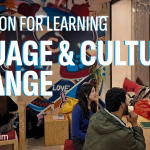
We also have a language programme, which is part of our wider work supporting the integration of refugees. It is based on an exchange around the French language and French culture.
We help refugees learn French, but this is not a traditional academic or classroom-based programme. It is much more social and cultural.
I am a refugee myself and I learned French after arriving in France. I experienced the cultural differences between France and Afghanistan first-hand. Many things were completely new to me.
It is the same for refugees and asylum seekers arriving from Afghanistan, Sudan, Syria, Iran, Pakistan, Bangladesh and many other countries.
That is why we created this programme.
The language programme takes place every Wednesday from 7 to 9 p.m. A volunteer first leads a discussion on a particular topic for around thirty minutes. The participants are then divided into small groups, usually with one volunteer and two or three beneficiaries. They discuss the topic according to their level of French.
Some participants are complete beginners, while others are already able to have a conversation in French but may need more support with reading and writing.
It is a real two-way exchange. Volunteers and beneficiaries learn from one another. The beneficiaries learn French and discover French culture, while the volunteers also discover the cultures of the people they meet.
For example, if the topic is food in France, volunteers might also discover traditional food from Afghanistan, Sudan, Syria or another country.
We also offer opportunities to exchange around the English language and culture. As we are an English-speaking organisation, we have many English-speaking volunteers.
Some refugees and asylum seekers come to us specifically to practise English. We also have French students who come to practise their English, sometimes on the recommendation of their teachers.
Beyond language learning, we also want to help refugees integrate into French society by giving them the opportunity to become volunteers themselves.
For an asylum seeker who spends a lot of time at home, this can be extremely important. Isolation can have a negative impact on a person’s well-being, and they may not have many opportunities to practise French or discover French society.
At Serve the City, they can learn French, volunteer and meet people from many different backgrounds.
We have received a lot of positive feedback from beneficiaries. Some have told us how these activities helped them learn the language and understand French culture.
Volunteering can also be useful as part of their wider integration journey. When an asylum seeker has to present their case before the National Court of Asylum, for example, they can demonstrate the concrete steps they have taken to integrate into French society: learning the language, playing sport, taking part in social activities or volunteering.
When someone volunteers with us for at least three months, once a week, we can provide them with a certificate confirming their involvement. This can demonstrate their commitment to becoming part of French society.
We can also mention their participation in our language programme.
We have a sports programme as well. Sport is another important part of our work around inclusion.
We also organise occasional activities linked to professional integration. We are not a specialist employment organisation, but we work with companies that want to organise solidarity activities with us.
They can take part in food distribution, help prepare meals or join our language programme, where we often need French-speaking volunteers.
They can also share their professional experience: how to find a job, how to write a CV or how to prepare for an interview.
We have organised this type of activity with companies such as Amazon, Google and UPS, as well as with law firms.
We also work with different partners on solidarity initiatives, including the distribution of hot meals.
Florent: That is fantastic, because you are really creating a multicultural environment based on diversity. It is a genuine win-win situation, because everyone becomes stronger through cultural diversity.
You were also recently present at the European Aquatics Championships. How did that opportunity come about for Serve the City, which is also involved in sport?
Nathanael: During the ChangeNOW conference in April, we helped set up a coalition of organisations working with migrants through sport and solidarity.
There were six organisations involved. It was there that we met representatives of the French Swimming Federation.
We developed a good relationship and subsequently organised our participation in the European Aquatics Championships during the summer.
The idea was to bring both volunteers and beneficiaries to the championships. The Federation gave us a tent and a space in the solidarity area for supporters.
It was a very special experience. We spent three days there with another organisation that supports migrants through sport.
In July, they also offered swimming lessons to young beneficiaries, both girls and boys. Fifteen people took part in the swimming lessons.
We were also able to obtain tickets for volunteers and beneficiaries to attend the championships.
Florent: Fantastic! Sport is such a powerful way of promoting inclusion and bringing people together. When and how did this sporting dimension become part of Serve the City’s work?
Nathanael: The sports programme was created in March 2024, and we started taking part in an official FSGT championship in September of that same year.
At the beginning, I simply approached boys and young men I met in the street and asked them: “Would you be interested in playing football?”
I am a football coach, and I had recently arrived in Paris. I wanted to get involved with an organisation.
I found an open football pitch in the 10th arrondissement. I created a WhatsApp group and invited anyone who was interested to come and play with us.
At first, we had around 40 players. That was huge for a first experience, especially because the pitch was quite small!
Then, after the first summer, word of mouth really took off. People started talking about it and the WhatsApp group remained open.
We welcomed many young men and women from different countries.
Today, around fifteen nationalities are represented in our programme among both players and volunteers.
We have many people from West Africa, including Mali, Côte d’Ivoire, Guinea-Conakry and Sierra Leone.
We also have players from Afghanistan and Sudan, as well as from North Africa, including Egypt, Algeria and Morocco.
It is a very diverse and open environment.
If a player wants to continue with our team or join another team that supports young people through football and sport, we try to make that transition possible.
Florent: It is also a great way to develop skills and build connections.
Could you tell us about the SAVE programme, which supports volunteers while helping them develop skills and gain certification?
Safi: At Serve the City Paris, we created a programme designed to empower people. It is called SAVE, which stands for Serve Action, Value and Empowerment.
The idea is simple. If a volunteer, particularly a young person or student, identifies a problem in society and thinks they may be able to find a solution, they can work with our team to develop their idea.
They start by looking at the problem, researching possible solutions, developing their idea and then moving towards implementation and testing.
The programme is particularly aimed at young people and students who want to become involved in solidarity projects.
During three or four workshops with our programme leader, they identify a problem, ask the right questions, research a solution and present the results of their work.
At the end, we can provide them with a certificate.
This is actually how our sports programme developed. A volunteer came to Serve the City, discovered our activities, met our team and thought about what they could contribute. Today, we have a fully developed sports programme.
We followed a similar approach with our language programme.
Some volunteers realised that certain beneficiaries were illiterate. How can someone learn French if they cannot read?
Even though our language programme offers different levels, it can be difficult for someone who cannot read to join a conventional language programme.
So our volunteers thought about how we could help these people acquire the basics of French.
We subsequently supported five people over a three-month period. They learned the basics of French and recently completed the programme.
We have developed several similar activities involving young women and young men. They participate in the projects and can receive certification for their involvement.
Florent: That is fantastic and very meaningful. Congratulations!
World Refugee Day is also a symbol of what you experience every day. Can you tell us how you thanked your volunteers and partners?
Safi: We wanted to thank our volunteers in a slightly different way, creating another win-win situation.
We organised the event in collaboration with the American Church in Paris, which has a large hall and a large kitchen.
We chose 20 June, World Refugee Day. At Serve the City, our beneficiaries represent more than 21 nationalities, while our volunteers represent more than 30 nationalities. That means more than 50 nationalities are represented within Serve the City Paris.
For the occasion, we asked our Sudanese beneficiaries to prepare traditional Sudanese dishes and introduce the others to their culture.
For around ten minutes, they talked about their culture and traditions with volunteers and other participants.
Then we shared the Sudanese food and danced to music from several countries, including Sudan, Afghanistan, India, Benin and Yemen.
That is how we celebrated World Refugee Day on 20 June 2026.
It was also a way of telling our beneficiaries: “We see you, and we are giving you the opportunity to express yourselves. You have things to share with other people.”
Throughout the year, volunteers accompany them, help them learn French and discover French culture.
This time, it was the beneficiaries who had the opportunity to give something back to the volunteers.
Florent: To make your work as effective as possible, do you also exchange experiences with your counterparts in the Serve the City network abroad?
Safi: Yes. Serve the City Paris is a chapter of Serve the City International, a network that is present in more than 27 countries.
Every year, we have international events. We have, for example, taken part in a gathering in Brussels to celebrate an anniversary of the network.
We share our experiences with our colleagues.
For example, we can explain how we organise our language programme and how we choose topics that are relevant to refugees.
They also share their experiences with us.
Each Serve the City chapter has its own priorities. In Paris, we focus particularly on refugees and people experiencing homelessness. In London, the Philippines, Australia or Kenya, the needs and activities are different.
But we share our experiences and learn from one another.
We also have another activity called City Exchange. Once or twice a year, we bring together around ten participants from different Serve the City centres.
We discuss different topics and share our experiences in order to become more useful and create greater impact in the communities where we work.
Nathanael: I am very happy that you asked this question.
We know that migration is a global issue, but above all, it is a human issue.
We believe it is our responsibility to welcome and support people who are in exile, or simply far from home, and who are doing their best to integrate into French society.
Many of us, as volunteers, are not originally from France either. We are also doing our best to navigate our own integration journeys.
We believe that cultural exchange and helping one another along our respective journeys enrich our lives and encourage everyone to become more involved in their local community.
Florent: That is really wonderful, and it is something that you can see happening in Paris every day.
Once again, congratulations, Safi and Nathanael. Gratitude, sharing and living together, with humility and agility — that is what you put into practice every day.
How did you become involved with Serve the City?
Safi: I arrived in France in June 2021. I was an asylum seeker and I didn’t have a job.
I was looking for somewhere to learn French. Since it was during the school holidays, I searched on Google.
The first organisation I found was Serve the City Paris.
So I came to learn French. I met the head of the organisation, who encouraged me to take part in other activities, particularly food distribution.
When I discovered that there were also people who spoke English, it made things much easier for me.
I started coming once a week.
Later, I obtained refugee status and the organisation offered me a part-time position.
Since then, the activities have grown considerably and I am now responsible for operations on a full-time basis.
Nathanael: As for me, I moved to Paris in October 2023.
I am American, but I studied in the Netherlands, where I met my girlfriend.
I discovered Serve the City through a friend who was volunteering with the organisation. They told me it was very easy to get involved and participate in the activities.
I started with food distribution in the streets.
Then, after two months, because I am a football coach, I wanted to use my skills to contribute to the organisation.
That is how I became involved in the sports programme.
Florent: That’s fantastic!
Can we share the contact details, social media and website for Serve the City?
Safi: Of course. The website is servethecity.paris.
All the information is available on the website. We are also on Facebook and Instagram.
If anyone is interested in taking part in our activities, they can visit our website and also see our videos and photos on Instagram.
Florent: Once again, congratulations on everything you are doing every day.
What would you like to see for Serve the City — and for yourselves — in the future?
Safi: With our language programmes, integration activities and all our other initiatives, we want to continue becoming more effective by learning from our experience.
We also want to strengthen our network with other organisations working in France, particularly in Paris.
Above all, our goal is to create more opportunities for refugees and asylum seekers to participate in our organisation and, through that participation, to support their integration into French society.
Florent: Thank you very much, Safi.
Safi: Thank you very much, Nathanael, for this interview.
Florent: Take care of yourselves and your loved ones.
Safi: Thank you. You too.
Nathanael: Thank you, Florent.