
In Paris, thousands of people are living on the streets. But when I joined food
distributions, I noticed that I rarely saw any women. It made me wonder-where are they?
The truth is, many of them are hidden in places like family camps or inside buildings,
which makes them invisible and often underrepresented. This is exactly the issue Not
Alone75 is tackling. It organises the community kitchen, offering a place where
refugee women, often with kids, can express their needs and feel a sense of
community.
On April 10th, I joined a grocery run for the community kitchen in Château rouge,
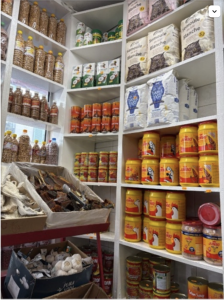
alongside other staff and beneficiaries. We hopped between several stores such as a
supermarket, a Congolese poissonnerie, and a local épicerie. Those stores were bustling!
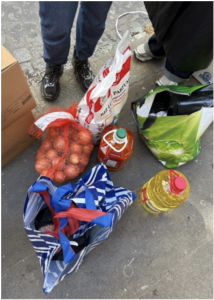
Congolese ladies knew exactly what they were looking for, picking out ingredients for
the dishes they had planned for Saturday: cassava, rice, chicken legs, paprika, etc. Since
we were shopping for about 50 to 60 servings, everything came in enormous quantities.
I usually just go to the supermarket to do grocery shopping, so I was surprised by the
variety. So many special ingredients and condiments from all across Africa!
That morning, I joined the grocery run with Anja, the founder of the community
kitchen, and I asked her about the initiative and support it offers to women specifically.
She told me that she started the community kitchen mainly for pregnant women and
mothers with children, after noticing that many existing support systems are designed
around the “average” beneficiary, maximizing the number of people reached, but often
leaving more vulnerable groups behind. “Female refugees and homeless women are
often more vulnerable, as many of them face risks of being stalked or experiencing
violence while living on the street.”, she explained. As a result, many women end up
sleeping in places like parking garages, the hallway of code-locked apartments, or
women-only shelters, making them essentially invisible to passersby or aid
organizations. Anja pointed out that for women, especially those who are pregnant or
caring for young children, general refugees and homeless support may not fit their
needs. So, what she did first was to ask. She asked refugee women what they actually
needed; they answered that they wanted to cook their own food. And that’s how the
community kitchen was born. Not Alone75 covers the cost of groceries and provides a
space where women can cook and share meals together. Anja was clear that respecting
the autonomy and freedom of beneficiaries is one of the core values. “Beneficiaries
cook for others themselves, with the help of volunteers, so they get to choose what they
eat, while also staying connected to their culture and community through sharing local
specialties.” Anja said. The balance of support and independence really inspired me!
She also introduced some important ground rules to me when interacting with children
at the shelter. Since much of the volunteers’ work involves looking after kids while the
women cook, there are clear guidelines: limited physical contact, no photos of kids, and
no photos of kids posted on SNS. For newcomers, handing their children to strangers
requires an enormous amount of trust. So, Anja is intentional about keeping the
volunteer group small and consistent at first, giving the staff the chance to build genuine
relationships with the families and earn that trust over time.
After the shopping, we went to the shelter to drop off everything we bought. When I
walked in the building, I noticed a very welcoming and lively atmosphere, with children
playing and running everywhere. Anja mentioned that the community kitchen connected
her to different cultures. There’s often festive music playing, and sometimes children
and mothers start dancing to it. Also, when it comes to cooking, Congolese people do
not compromise. It often takes three to five hours to cook as the sauces are sometimes
made from scratch, simmered for a long time. The servings are usually for 50 to 60
people, so you can imagine how hard it is to even estimate when it’ll be ready. But
quality comes first!
The next day, I met up with other volunteers at the shelter in the 18th arrondissement to
help out at the community kitchen. There were already lots of women and young
children, and our main job was to play with children and keep an eye on them. The
kitchen already smelled incredible when I arrived! Outside, the kids were full of energy,
some played with toys or read books, while others ran out to play football or ride
minibikes. I joined in a game of “1, 2, 3 Soleil!”, and got sent straight back to the start
for flinching. They were not going easy on me. The kids warmed up quickly and got
mischievous and playful in the best way. With 10 to 20 kids to keep track of, it took us
real focus, and sometimes it took strength to break up a small fight among them, but I
genuinely loved keeping them company and playing with them!
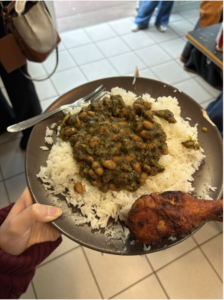
For lunch, we were served a Congolese dish: beans and cassava over white rice, with
fried chicken. It was delicious! We all sat together at a long table, and we all shared a
beautiful meal.
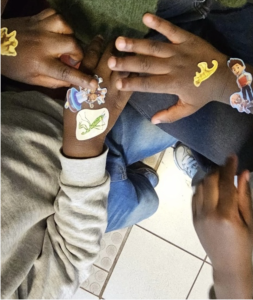
I got to chat with two ladies from Congo during the day. Their experiences and
duration of their involvement differed. Cristal recently found out about Not Alone75
through an acquaintance. Since she was very new, she hadn’t formed many strong
opinions yet, but she told me that she appreciated the welcoming atmosphere there and
how nice it feels to share a meal with others. Carina, who was one of the women
cooking that day, first heard about the kitchen through a social initiative at the Hôtel de
Ville. She said that the community kitchen offers her a place to rest, and a big help in
taking care of children before they were old enough for school. She loves sharing food
with other people, and these days, she also finds joy in cooking for others, channeling
her love of cooking as well as helping look after other kids. I think the community
kitchen is a great opportunity for these women to connect with others and support each
other. Especially sharing meals and moment creates a sense of community and
solidarity.
I also spoke with Maria, one of the Not Alone 75 team members. As she has
volunteered throughout her life, she realized her leadership and start-up thinking can be
useful to help build out the organization through things like an official website,
platform, and data bases. She mentioned emotional complexities and things to be
mindful of in this kind of work. Some of the children may have experienced real
hardship, trauma, and instability, so it takes patience and understanding when they act
out. The kids can be rough sometimes, I saw some of them start screaming crying or get
angry at times, but what we can do is to empathize with them and be by their side with
love. But Maria said the women are very talkative and warm, and the children gradually
open up as they get more comfortable with familiar faces.
The idea Maria kept coming back to was the difference between “helping” and
solidarity. She explains that one-sided helping is often linked with pity which creates a
vertical relationship and a distance between the helper and beneficiaries while solidarity
restores a horizontal relationship and deep empathy, without any pity or control. She
emphasizes that it’s very important to create a safe space where women can define their
own needs and realize it through collaboration with them. That distinction hit me. This
isn’t a place where people receive help passively, but a place where people cook, share,
laugh, and build something together. And that makes all the difference.
In Paris, there are several organizations that offer aid for refugee women.
If you’d like to learn more, here are some organizations that provide shelters or
accommodations for women:
・FIT(Une Femme un toit): offer a social housing and reintegration center as well as
emergency accommodation center for women aged between 18 and 25 without children
who are victims of sexist and/or sexual violence, and living in a precarious situation.
https://www.associationfit.org/l-association
・HHU(Habitat & humanism Urgence): Provide shelter and support along with legal,
medical, professional support, including job training, housing, and cultural integration
programs.
https://www.habitat-humanisme.org/le-mouvement/urgence/
・Emmaüs Solidarité -Centre d’Ivry: Run a large migrant emergency accommodation
center with around 450 places.
https://www.emmaus-solidarite.org/sur-le-terrain/les-hebergements
・Singa-J’accueille: Connects refugees with French residents who are willing to
facilitate refugees, ranging from a few days to several months of experience living with
locals.
https://www.jaccueille.fr/je-découvre
・Réfugiés Bienvenue: Mobilize a network of individuals in Île-de-France to host
refugees free of charge in their homes.
A huge thank you to Not Alone 75 for welcoming us into this community and allowing
me to witness such meaningful work! And thank you to Anja and Maria for sharing
your time, vision, and passion with me, and to Cristal, Carina and all the women and
children at the kitchen for letting me be part of your day.
Written by Arisu Kanno